Saturday, December 18, 2010

Our Pagan Winter Holiday

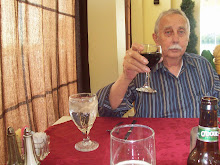
My wife and I are pagans. Thus, our winter holiday celebrations differ a bit from your Christian ones. The festivities really start in November when we sacrifice a large bird and eat it garnished with bountiful products of the Nature goddess, such as cranberry sauce, several types of vegetables followed by such pagan favorites as pumpkin and apple pies.

Before dinner we give thanks to Zeus (sometimes known as Jupiter) for all the good things in our life.

Then on the following day (known as Dark Friday), we get up early in the morning and stand outside the doors of a mall or other commercial enterprise to rush in grab at bargain prices the items we need for the Saturnalia Holiday, such as brooms, Cheetah pets, and other occult items.

On the eve of the Saturnalia, we attend the Temple of Apollo, where we drink the blood and eat the meat of a sacrificial lamb (not really blood and lamb meat, but red wine and cookies blessed by the Apolloian priestess). We decorate our homes with lights, candles and ornaments and hang up such herbs as mistletoe (which is supposed to bring love).

The center piece is the Yule tree dedicated to the god Bacchus which we decorate with lights and other ornaments.

Before we send the children to bed, we tell them about the god Woden who rides his white horse with eight legs through the night delivering gifts to children. Woden is a jolly overweight god with a white beard, a red suit who lives in the far north with elfish helpers. Sometimes we take out our Book of Shadows and read the story of Mithra. The goddess was born in a cave and adored by shepherds who offered the first-fruits of the harvest to her. Animals and important travelers also came to the cave to worship Mithra.

After the children open their gifts from Woden on Saturnalia morning, we sacrifice another bird in honor of the Phoenix, the bird that rises out of its ashes, and feast on it. Afterwards we exchange gifts and toast each other and the gods. Sometimes we sing hymns to the gods or dance in a magic circle. Saturnalia is good time for friends and relations to get together.

Happy Holidays everyone, whether you celebrate Christmas, Saturnalia, Hanukah, Kwanza, or some other Winter Solstice holiday.

Saturday, December 11, 2010

2001 The Movie

One of the best science-fiction movies of all time was Stanley Kubrick's 2001, A Space Odyssey. Many people nowadays wonder what the big deal was with this movie. They have only seen it on the small screen. With digital special effect in more modern movies, the special effects seem ho-hum. In 1968, in a theatrical release, it was spectacular. I was one of the lucky ones who saw it in Cinerama in a wide-screen theatre. It was nothing short of mind blowing.

The film deals with thematic elements of human evolution, technology, artificial intelligence, and extraterrestrial life, and is notable for its scientific realism, pioneering special effects, ambiguous imagery that is open-ended to a point approaching surrealism, sound in place of traditional narrative techniques, and minimal use of dialogue.

In my opinion such movies as Star Wars and Alien probably would not have been made were it not for the success of 2001. It was the first movie to show that a serious SF film with great special effects could draw a large audience. Perhaps one of the reasons for this was that the Apollo space program and other NASA space probes were gaining popularity. It was only a year later that Lance Armstrong and Buzz Aldrin stepped onto the surface of the moon. Four years later Pioneer 10 had reached the planet Jupiter.

For those of you who had never saw the movie, here is a synopsis (warning, it contains spoilers): The movie starts millions of years ago when a group of subhumans are competing with tapirs and other homids for food. One morning a tall, thin, rectangular black monolith stands among the rocks. The apemen are excited but touch the object and calm down. By touching the monolith, they have learned to use bones as weapons and tools.

In the next scene the action moves to the near future where travel to the moon is an every day affair. A similar monolith is found on the moon and sends a signal towards Jupiter.

Eighteen months later a manned spacecraft is sent to Jupiter to investigate. Two of the team are awake to run the ship with the aid of an almost human AI called HAL. The other three are in hibernation. Hal announces that there is a problem with the AE-35 unit and it will fail with 100% certainty within 72 hours. The astronauts go EVA to replace the unit. The two astronauts scan the removed AE-35 unit but can't find any defects. Hal suggests putting it back in service to let it fail. Mission Control believes Hal has made an error because their HAL9000 unit, a twin to the one aboard Discovery, finds no flaw in the AE-35. Hal denies any chance of computer error. The astronauts go to a pod to have a private chat and decide to disable Hal's higher functions without disturbing the automatic ship control functions. Hal can see the men through the pod's window and reads their lips. When Poole goes out in the EVA pod, the pod murders him. When Dave uses a pod to recover Frank's body, a computer malfunction alert goes off and the life signs of the three hibernating astronauts flat line. Hal refuses to open the pod bay doors for Dave, explaining that he knows Dave is planning to disconnect him because he was able to read Frank and Dave's lips when they discussed it. He says the mission is too important to allow humans to jeopardize it. Dave releases Frank's body and maneuvers the pod to the emergency airlock hatch. He uses the pod's arms to open the door, holds his breath and jumps over to the ship. Dave goes to the computer room and shuts down HAL.

A much larger black monolith floats in Jupiter orbit,. Bowman leaves the Discovery in another EVA pod and enters a wormhole. The pod ends up somewhere in time and space in a bedroom with luminous white walls and floor and furniture in the style of Louis XVI. Dave ages swiftly until he is a dying old man. A monolith appears and transforms him into a star child.

If all of this sounds sort of mundane, it is because there is no way to describe the marvelous cinematography, special effects, music and emotional impact of the movie.

The idea for the movie was taken from an Arthur Clarke short story, The Sentinel. Clarke also wrote the script.

A sequel to the movie was released in 1984 called 2010: The Year We Made Contact starring Roy Schneider. The plot is based on Arthur Clarke's novel 2010: Odyssey Two.

It is a rather good movie itself, but nowhere as spectacular as 2001.

Sunday, December 5, 2010

The Fourth Dimension and Time

You've probably heard it said that the fourth dimension is time. This idea is especially popular with science fiction authors when writing time travel stories. But what does this mean? And what are the implications?

Forgetting about time for a while, in ordinary life we deal with three dimensions: left-right, forward-back and up-down. What this means is that every material object and every location in the universe can be described mathematically using only three numbers. When we measure a material object, its width, length and height are called its dimensions. If we want to describe the location of an airplane, we give its coordinates as latitude, longitude and altitude. Longitude is the distance from an imaginary line cutting through Greenwich England, latitude is the distance from the equator and altitude is its distance above the earth; in other words, the three dimensions of its location. For objects located on the surface of the earth, only two dimensions are required since altitude is not considered because from a human viewpoint, the earth is a relatively flat surface as long as we don't consider such features as mountains and tall buildings.

In mathematics, the number of dimensions is shown by a superscript. For example, a cube two inches at each dimension can be said a 23 inch cube (a two cubic inch cube). A two-inch line is a one dimensional object and can be written as 21 inch line. A two-inch square drawn on a sheet of paper would be 22 inch square (two square inch square). This also shows that objects of one, two or three dimensions can be illustrated by simple drawings or models. But, what about an object with four or more dimension? They can be shown mathematically by using superscripts (sometimes called powers) of 4, 5, or any number. But how do you illustrate such an object? For example, in a fourth dimensional object, how do you show a dimension at right angles to the other three?

Before I attempt to give an answer to the questions in the last paragraph, let's consider the attributes of objects in the lower dimensions. Imagine an infinite flat surface. On this surface, there is a line of infinite length. Let's say that there are number of points that live on that line. They can move left or right on that line but have no concept of the other dimensions. A point can never pass another point. Another race living on the surface are the Flatlanders. They can move left-right and forward-back but have no concept of up-down. A Flatlander could take one of the points and move it through the mysterious second dimension and put it on the other side of a fellow point. However, to the Flatlander, the line is an impassable barrier.

Now, as a three dimensional being, I have magical properties to the Flatlander. If I put my five fingers on the sheet of paper, the Flatlander sees me as five small blobs. If I remove a flat object into the third dimension, I can reverse it. The Flatlander first sees the object disappear and then returned reversed, an impossibility from his standpoint. I have other powers that Flatlanders are in awe of. I can appear and disappear within a closed space. I can see inside objects, including the Flatlanders' bodies. I can pick up a Flatlander and carry him across the barrier line. From this you can see that a fourth dimensional being would have similar extraordinary powers in our three dimensional world.

To get back to the question of illustrating a fourth dimensional object, we can show a three-dimensional object in two dimensions by opening it up. For example, a cube has six surfaces. If we unfold these surfaces into the form of a cross, we show the cube in two dimensions. The equivalent fourth dimensional object is called a hypercube and consists of eight cubes connected in four dimensions. If we unfold this into a three dimensional object, we would see eight cubes, four stacked on top of each other and the other four attached to one of the cubes in the stack, one on each side.

Now it is debatable whether time is actually a fourth dimension. But, for sake of argument, let's assume that it is. The implications of this are threefold. One is that all time, past, present, and future exist together in some way and that what we consider time passing is really only our traveling along a fourth dimension from past to present to future. It also seems to imply the possibility of travel in the reverse direction from the present to the past or speeding up our travel forward into the future. Thirdly, from the foregoing you can only come to conclusion that the future is predetermined, since it already exists and cannot be changed.

If you could view the fourth dimension (if it is time), you would see yourself extending to the point where you were born in one direction and up to the point of your death in the future. The same is true of everything around you. If not too distant in the fourth dimension, you could view any object from the point of its origin to its dissolution and all the changes that occurred to it.

Now a person who could travel into time would have some of the powers of a fourth dimensional being. He could appear in a locked room simply by going back in time when the room was not locked. He could disappear and appear somewhere else. He could predict the future.

In a previous paragraph, I stated that if time is the fourth dimension, our future is predetermined. This would also hold for the past. Thus, a time traveler who went to the past would not have a choice. He would by necessity have to have arrived from the future at the exact time of his arrival. This implies no free will, that even our thoughts are predetermined. To get around this problem and other paradoxes involved with time travel, one must conjecture other dimensions in which one can travel at right angles from not only to the usual three but from the fourth time dimension. This introduces the concept of parallel time.

The concept of parallel time is that starting from the beginning of the universe, each moment introduces infinite possibilities and each possibility exists somewhere (possibly in a fifth or higher dimension). So, if I go back in time and prevent my mother from meeting my father, two universes exist, one where I did not prevent my parents from meeting and one where I did. When I return to what I consider my own present, I actually return to a different universe from the one where I started from, one in which I was never born.

I hope this essay throws a little light on a confusing subject.

Saturday, November 27, 2010

Why Asimov's Three Laws Won't Work

In Science Fiction, the Three Laws of Robotics are a set of three rules written by Isaac Asimov, which most robots that appear in his fiction must obey. Introduced in his 1942 short story "Runaround," the Laws state the following:

A robot may not harm a human being, or, through inaction, allow a human being to come to harm.

A robot must obey the orders given to it by human beings except where such orders would conflict with the First Law.

A robot must protect its own existence, as long as such protection does not conflict with the First or Second Law.

If we could actually build robots who are intelligent enough to be self-aware, would these laws actually make sense. I propose not. Take the first law. In the first place, how could the robot tell a human being from another robot that looked like a human being or from a hologram of a human being. You might say, so what. As long as the robot cannot harm a human being or anything that resembles a human being, that is all to the good. But what if a humanoid robot or hologram and a real human being are both in danger. How would the robot know which one to save? As far as that goes, if two human beings are in danger at the same time, how does a robot know which one to save. (Note: this exact situation is shown in the movie I, Robot. In the movie the robot made the wrong choice.)

For certain uses, a manufacturer would not want to apply the Laws in that order. For example, suppose the robots are to be used for military purposes. In this case, the Laws built into the robot might go something like this:

A robot must obey the orders given to it by his superior officer.

A robot must protect its own existence, and those of other soldier robot, except where such orders conflict with the First Law.

A robot may only harm those human beings or robots designated as "The Enemy," by its superior officer and only if not under a flag of truce, surrendering or designated as "Prisoners of War."

In my novel, The Isaac Project, the situation of the military wanting to change the Three Laws provides part of the conflict in the book.

One error that Isaac Asimov made was that he assumed that the intelligence of the robot would somehow be in its electronic circuitry. Actually, we know now that the intelligence of a robot would more likely be in its software. This changes the situation quite a bit, since software can have errors in it that are not always detected during testing. Also, it can be modified. Depending upon how the software is installed, it might be subjected to viruses, worms, and other sorts of malicious software tricks by unscrupulous hackers, such as our computers are now.

Thursday, November 13, 2008

New group for writers and readers of science fiction

Some of you who read my blog may be authors or readers of science fiction, fantasy, paranormal fiction and/or dark fiction. I have started a group for authors and readers of these genres. Authors may promote their works at any time. Readers will find what's new in these genres and may comment on the books they've read or post anything having to do with these genres. To get started, click here

Sunday, November 9, 2008

The Invisible Minority

With the election of an African-American president, a women as a vice-presidential candidates, and another almost achieving the presidential candidacy, it would seem as though bigotry and prejudice were on the wane However, it is not dead by a long shot. In California a referendum against gay marriage was passed. Since 9/11 and the Iraq and Afghanistan wars, Moslems (and even Hindus) have suffered from bigotry. Bigots against many groups still exist.

Nonetheless, there are minority groups that suffer extreme prejudice that are not usually mentioned even by the so-called enlightened press except in a derogatory way. What groups am I talking about? Atheists, agnostics, the simply non-religious and pagans. In what ways are we non-believers in an almighty god discriminated against? Well let's take the sentence I have just written, by convention, the word "god" since it refers to the god of Christians and Jews is usually capitalized as though their god was somehow better or more important than other gods. If I would have referred to a pagan or Hindu god, it would not be capitalized.

One of the big ways that we non-believers are put upon is that we, as a group, are not allowed to be elected to public office. Oh, there is no law that states specifically that an avowed atheist or agnostic cannot run. But in every election, there is a litmus test. "Does the candidate believe in God?" is a question that is always asked. If the answer is no, the candidate has no chance in hell of being elected. In this last election, Senator Dole aired a TV ad that accused her opponent, Hagan, of taking "godless money" at a Boston fund raiser and linked her to an atheist group called the Godless Americans political action committee. The ad ended with a picture of Hagan and a woman's voice over saying, "There is no God." Hagan,who is an elder in her Presbyterian church and a former Sunday school teacher, responded with a lawsuit and her own ad, declaring, "I believe in God." The critics of the ad panned it because it was untruthful, not that calling someone an atheist was not derogatory. In fact Hagan is suing Dole as though she had said something really nasty.

What about TV? How many atheists, agnostics, and pagans have you heard being interviewed or otherwise allowed to state their views? Not many. Yet religious leaders such as televangelists, Catholic bishops, and the pope are given a lot of air time. Several cable channels are devoted to religion propaganda, but none devoted to the secular viewpoint. In dramatic shows, when a bad person becomes good, it is because he or she has a religious awakening. If a person loses his or her faith in religion, that person becomes despondent and unhappy and confused until they get their faith back.

It is axiomatic that religious people are good, kind and happy, while the non-religious are evil, cruel and unhappy. Really?! I am an atheist and consider myself good, kind and happy. There is nothing missing from my life as the religious propagandists claim.

The truth is that for all their prattling about love your neighbor, it is the fanatically, and some not so fanatical, religious that preach hate against other religions, gays and other groups. Many wars past and present, including the current ones in the Mideast, have been sparked by religion. In the middle ages, people were tortured and burned at the stake for having dissenting opinion with regard to the prevailing religion.

"One nation under god" is in the pledge of allegiance to the United States. "In god we trust" is on the money we use. Before it was banned, children were required to pray in a public school. Religious groups are working hard to reinstate this. In some public schools, unscientific philosophies such as "creationism" are taught as science.

How about taxation without representation? Priests, ministers, owners of religious property and so forth do not pay taxes, while the non-religious have to take up the slack. Since an atheist is not likely to be elected to public office, this is not about to change any time soon.

Yet there are very few groups working to end this bigotry and discrimination of the non-religious and pagans. We are truly an invisible minority.

Monday, December 3, 2007

Leaders, Do We Need Them

You've probably heard it often enough through your life such remarks as: "What we need is someone who is a leader," "Our program builds leadership," and "He was a great leader." I suppose for people who are not self starters or who cannot operate effectively unless told exactly what to do or are too lazy to put effort into making decisions, a leader is a necessity. But think about it, for most things, the majority of people get along pretty damn well in their daily lives without being told what to do. When organizing a group effort, most of the time people can reach a consensus fairly rapidly.

It seems to me that people who strive for leadership roles are egoists who think that they know better than other people how to run things. There is also the motive of having power over others. In addition, in most societies, leaders are honored and rewarded.

In my view so-called "leaders" do more harm than good. The stronger the leader, the more arbitrary and dictatorial are his or her decisions. Think about some people who were considered great leaders, Napoleon, Hitler, Stalin, Lenin, Ghenghis Khan, Julius Caesar. It is power hungry leaders and their sheeplike followers who make war, order genocide, and oppress people.

Of course many organizations in a modern society are organized hierarchically. I believe this stems from the olden days when emperors, kings and religious leaders who organized according to a military standard. In a hierarchical organization power starts from the top and propagates downward. This gave the power hungry the ability to lord over others. In today's world, this also holds true, although in democratic countries such as our, the leader's drive for absolute power is somewhat tempered by other forces.

But the truth is that most organizations would probably run as smoothly without a leader. It is the much maligned bureaucracy who keep the organization going. When important decisions had to be made, they could be made by experts after due consideration, perhaps in committee.